
How to Seal a Driveway in 2026 — Step-by-Step Guide
Updated June 2026 — includes 36-month real-world test results
By Nanoprotect USA Testing Team — Real-world field testing since 2003
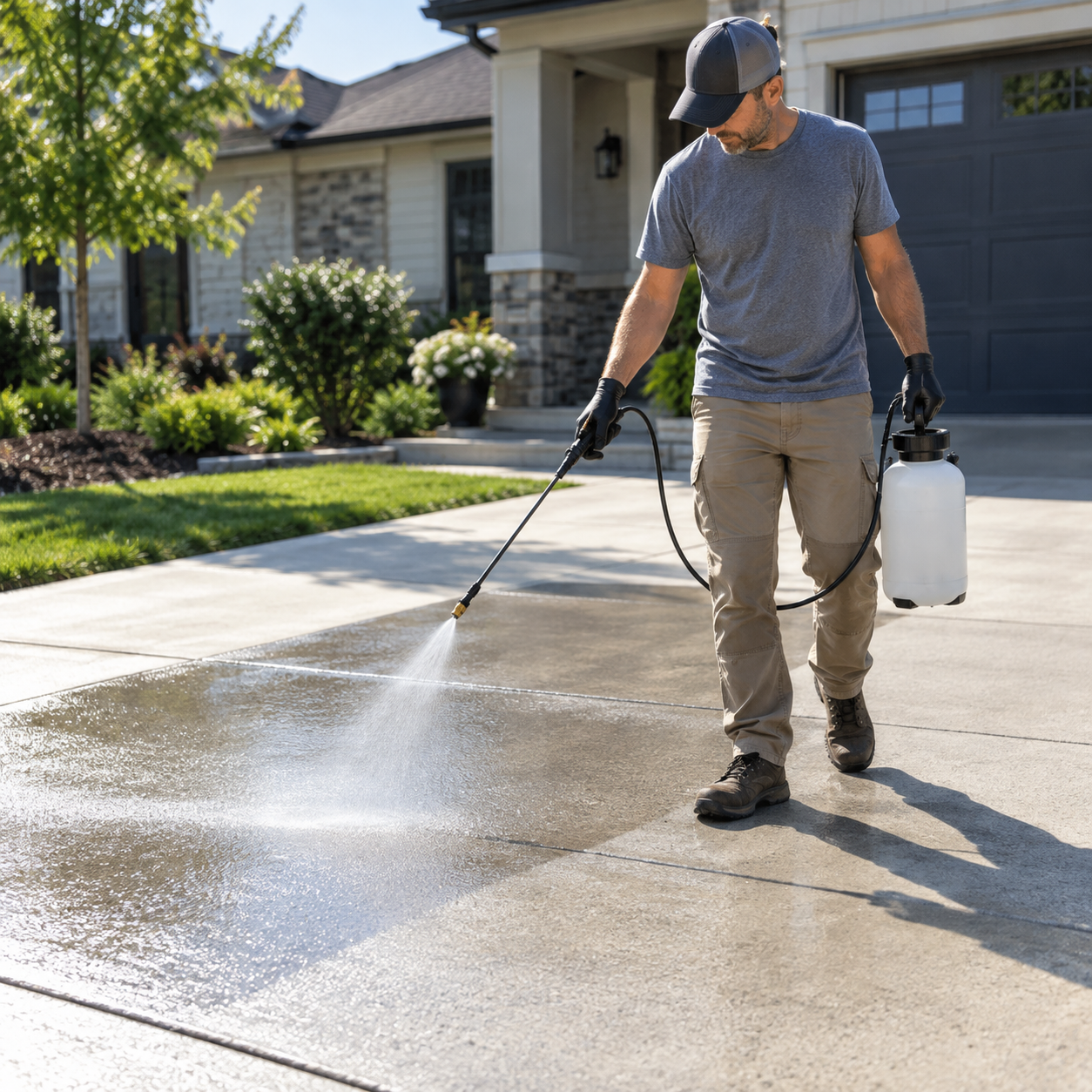
Sealing your driveway is one of the highest-ROI home maintenance tasks you can do. A single afternoon of work protects your concrete from water damage, algae, oil stains, and freeze-thaw cracking — for years, not months.
This guide walks you through exactly how to seal a driveway the right way, including the mistakes most homeowners make that cause sealers to fail within a season.
Watch: How to Seal Concrete the Right Way
Before diving into the steps, watch this quick walkthrough showing the correct application technique for a penetrating concrete sealer:
What You'll Need
- Penetrating concrete sealer (1 gallon covers 135 sq ft double seal wet-on-wet (recommended), or approx. 200 sq ft single coat)
- Pump garden sprayer or roller with 3/8" nap
- Stiff-bristle brush or broom
- Pressure washer or garden hose
- Safety glasses and gloves
Step 1 — Clean the Surface Thoroughly
This is the most critical step. Sealer bonds to concrete, not to dirt, oil, or algae. If you skip proper cleaning, the sealer won't penetrate and will fail within months.
- Sweep away all loose debris, leaves, and dirt
- Pressure wash the entire surface — minimum 1,500 PSI
- For oil stains, use a degreaser before washing
- For algae or moss, use a diluted bleach solution (1:10) and scrub with a stiff brush
- Let the surface dry completely — at least 24 hours after washing
Pro tip: Pour a small cup of water on the concrete. If it beads up, the surface may have an old sealer that needs stripping first. If it absorbs within 30 seconds, you're good to go.
Step 2 — Check the Weather
Temperature and moisture are critical for proper curing. Apply sealer when:
- Temperature is between 50°F and 90°F
- No rain is forecast for at least 24 hours
- The surface is completely dry
- Avoid direct hot sun if possible — early morning or late afternoon is ideal
Step 3 — Apply the First Coat
For a penetrating sealer like Nanoprotect, use a pump garden sprayer for the most even coverage. Work in sections of about 10 square feet at a time.
- Hold the sprayer nozzle 6–8 inches from the surface
- Apply in a sweeping motion, overlapping each pass by about 2 inches
- The concrete should look wet and saturated — not pooling
- Work backward toward the exit so you don't step on wet sealer
Coverage: 1 gallon covers 135 sq ft double seal wet-on-wet (recommended), or approx. 200 sq ft single coat. Measure your driveway first and use our coverage calculator to get the right amount.
Step 4 — Apply the Second Coat (Wet-on-Wet)
For maximum long-term protection, apply a second coat while the first coat is still wet — this is called a wet-on-wet application. Don't wait for the first coat to dry.
- Apply the second coat in the opposite direction to the first (perpendicular)
- Use the same sweeping motion and overlap
- The surface should look uniformly saturated
A single coat provides basic protection. A double wet-on-wet coat is what delivers the full 36+ month protection that Nanoprotect is known for.
Step 5 — Let It Cure
Keep foot traffic off for at least 4 hours, and vehicle traffic off for 24 hours. Full cure takes 48–72 hours depending on temperature and humidity.
During curing, keep the surface dry. If rain hits within the first 4 hours, you may need to reapply.
How Long Does Driveway Sealer Last?
Most surface-coating sealers last 1–3 years before peeling or wearing off. Penetrating sealers that bond at a molecular level last significantly longer.
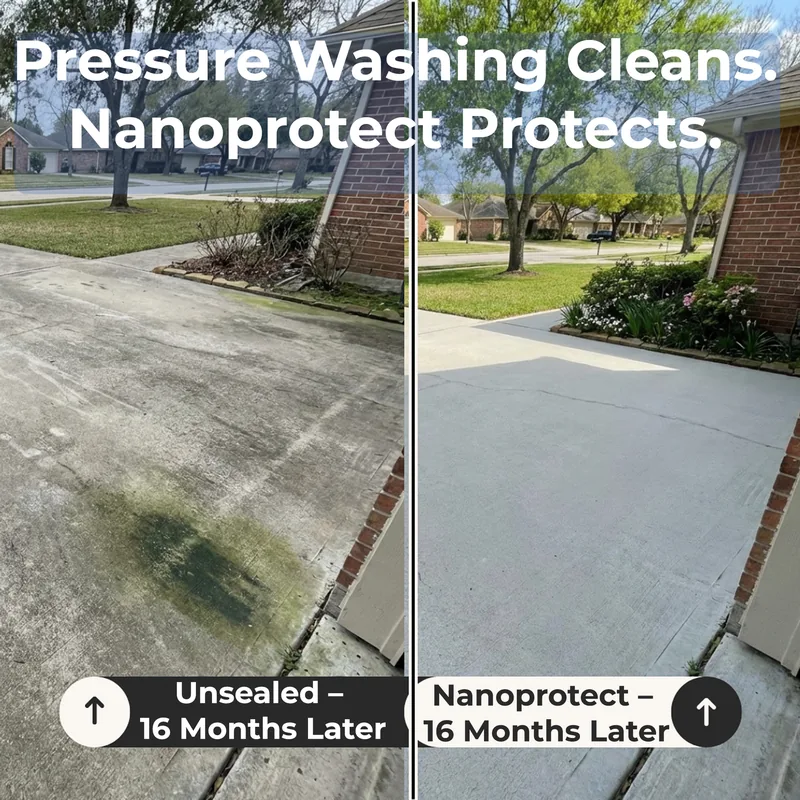
Nanoprotect's real-world field test: applied in July 2023, the sealed half of a patio was still fully protected at the 32-month checkpoint — test ongoing, now 36+ months. The unsealed half shows significant algae growth, staining, and surface deterioration in the same period.
Common Mistakes to Avoid
- Sealing dirty concrete — the most common cause of early failure
- Applying in hot direct sun — causes the sealer to dry before it can penetrate
- Using a surface coating on absorbent concrete — will peel and flake within a season
- Applying one thin coat — insufficient penetration, won't last
- Not checking if old sealer is present — new sealer won't bond over old coating
Penetrating Sealer vs Surface Coating — Which Should You Use?
There are two main types of concrete sealer:
- Surface coatings (acrylic, epoxy) — sit on top of the concrete, look glossy, peel and wear off within 1–2 years
- Penetrating sealers (silane, siloxane, nano-technology) — absorb into the concrete pores, invisible finish, last 3–10 years
For driveways exposed to vehicle traffic, freeze-thaw cycles, and UV, a penetrating sealer is always the better choice. It protects from the inside out rather than forming a surface film that can crack and peel.
How Much Sealer Do You Need?
A standard two-car driveway is approximately 400–600 square feet. At 135 sq ft per gallon (double coat), you'll need 3–4 gallons for a standard driveway.
Use the Nanoprotect coverage calculator to get the exact amount for your surface dimensions.