
Surface planning · Practical guidance
Driveway Sealer: A Practical Guide to Concrete Care
Start with the driveway you have—not a claim on a bottle. Identify the material, check water absorption, and choose a treatment that fits your concrete and the finish you want.
First identify what your driveway needs
Driveway sealer is a broad category, not one interchangeable treatment. Asphalt and concrete are different materials: a black asphalt maintenance coating is not a penetrating treatment for concrete. This guide concerns absorbent concrete driveways. If your entrance includes brick or concrete paving units, the paver sealer guide explains the separate questions around joints and individual units.
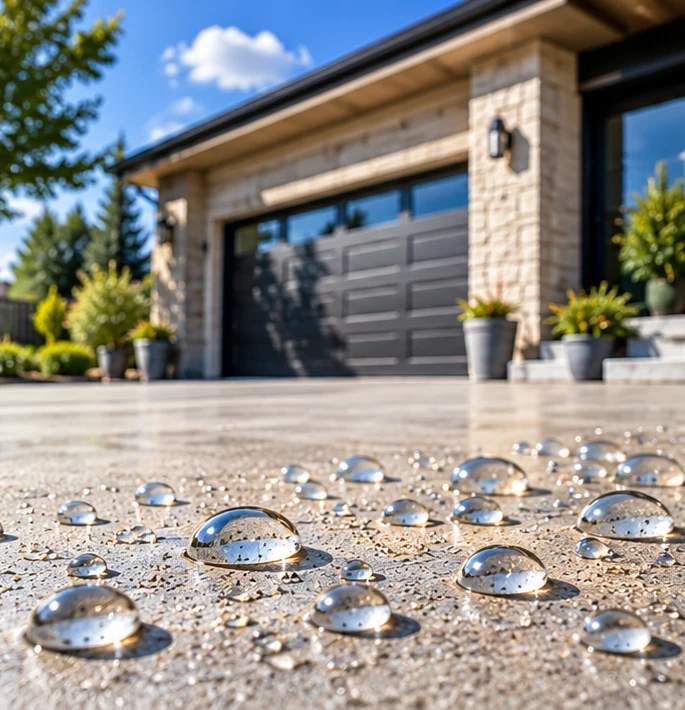
On sound, uncoated concrete, water can enter connected pores and darken the surface. A suitable water repellent helps reduce that absorption. It does not level a settled slab, fill a crack, repair scaling or correct water collecting beside a garage. Inspect those conditions before sealing so the treatment is not expected to solve a construction or drainage problem.
Read the surface before choosing a product
Clean a small representative area and observe whether a little water absorbs. Compare exposed concrete with sheltered edges. Persistent beading may indicate an earlier treatment; a visible shiny layer suggests a coating. Neither observation identifies the old product conclusively. Check maintenance records and confirm compatibility rather than applying a new material over an unknown finish.
Penetrating driveway sealer or a surface coating?
A penetrating driveway sealer works within an absorbent substrate. NanoProtect Concrete & Masonry Sealer is a water-based, breathable silane/siloxane treatment that repels water without forming a decorative surface film. It is a candidate when a natural appearance and reduced water absorption are the goals. The concrete sealer guide explains the broader distinction between water repellency and waterproofing.
Film-forming products create a layer on top. Some acrylic systems are chosen for gloss or color enhancement; other coating systems have different intended uses. Check the specific system's outdoor suitability, moisture requirements, finish and maintenance instructions. It is not useful to assume every coating peels or every penetrating formula performs identically.
Match the finish to the job
Choose a decorative coating if its finish is the purpose of the project and the substrate meets its requirements. Choose a compatible penetrating treatment when you want the exposed concrete to retain its natural look. Neither choice substitutes for structural repair. Treat stamped, colored or previously sealed concrete as a compatibility question and approve a small test area first.
Prepare an exposed concrete driveway carefully
Remove loose dirt and organic growth, then address oily spots and cleaning residues with methods appropriate for the slab. Sealer does not erase existing stains. Excessive cleaning pressure can damage a weak surface, so use a suitable technique rather than chasing an uneven color with more force. Rinse as required by the cleaner and check that residue is not blocking absorption.
The substrate must be dry before penetrating treatment. A sunny top surface can appear ready while shaded edges remain damp. Recent rain, washing, humidity and low spots all affect drying; a universal overnight waiting period is unreliable. New concrete also needs adequate curing, and curing compounds may require preparation before a water repellent can penetrate.
Check the product label for application conditions and the rain-free curing window. Protect adjacent paint, glass, plants and other materials from overspray. Complete repairs and resolve standing water first. Schedule the work so the treated area can remain undisturbed for the label's return-to-use requirements.
Apply evenly without leaving excess
- Test a representative patch. Confirm absorption and the cured appearance on clean, dry concrete. Include a rough or shaded area if it differs from the main slab.
- Prepare the correct dilution. Ready-to-use packages need no mixing. For concentrates, follow the instructions for that exact size and measure the final ready-to-use volume.
- Work in manageable sections. Distribute treatment evenly using suitable equipment. For recommended wet-on-wet saturation, make the next pass while the previous application remains wet. Absorbent sections may require additional passes; two is not a universal maximum.
- Wipe unabsorbed excess. Do not leave puddles or residue to dry. Protect the area while it cures and follow the label before returning it to normal use.
Keep a record of area treated and liquid used. Changes in texture can change consumption, so the test section is more useful than assuming a whole driveway will absorb uniformly. If treatment remains on top rather than entering the concrete, pause and reassess compatibility instead of adding more.
Maintain the slab, not a promised lifespan
Reduced water absorption helps protect against deicing salts and freeze-thaw exposure, but damage can still occur. Drainage, concrete condition, porosity and maintenance all matter. Remove spills promptly and clean with a method suitable for the concrete. Water repellency does not mean complete resistance to every stain or chemical.
Periodically compare absorption on clean representative spots and inspect cracks, low areas and surface changes. Beading alone is not a complete performance test. Follow the label when considering another treatment rather than adopting a guaranteed resealing interval. Save application notes and photos as maintenance records, not proof of a fixed service life. For an outdoor seating area with different cleaning concerns, see the patio sealer guide.
Plan your driveway coverage
Measure the actual slab, splitting curves or irregular areas into smaller shapes. One ready-to-use US gallon provides approximately 135 sq ft for recommended wet-on-wet saturation, or up to 200 sq ft for a single coat, depending on porosity and texture. Single-coat coverage does not imply the same treatment depth as saturation.
For a measured 500 sq ft area, 500 ÷ 135 is about 3.7 ready-to-use gallons before allowing for actual surface consumption. Concentrate quantities refer to the diluted volume. Use the calculator to compare required packages, then check consumption on your test patch.
Coverage Calculator
Find the right size for your driveway.
Recommended for your project:
Enter your surface size to see recommendations
NanoProtect sizes for your measured project
- 32 fl oz Spray Bottle — ready to use, no dilution.
- 1 Gallon Ready-to-Use — ready to use, no dilution.
- 33.8 fl oz (1 L) Concentrate — makes about 3 ready-to-use US gallons after dilution.
- 5 Gallon Ready-to-Use — ready to use, no dilution.
- 64 fl oz Ultra Concentrate — makes about 6 ready-to-use US gallons after dilution.
Driveway sealer questions
Can concrete driveway sealer be used on asphalt?
Do not assume compatibility. Asphalt maintenance products and concrete water repellents serve different materials. Use a treatment labeled for your substrate; this guide and its coverage figures concern suitable absorbent concrete.
Should I seal a driveway with existing oil stains?
Clean the stains first using a suitable method, then reassess absorption. A penetrating sealer helps reduce surface staining but does not remove discoloration or guarantee resistance to oil. Residues can interfere with treatment.
Does driveway sealer fix salt-related scaling?
No. It is not a repair material. Address deteriorated concrete separately. Reducing water absorption helps protect sound porous concrete against deicing salts and freeze-thaw exposure, without guaranteeing that scaling cannot develop.
What if water already beads on my driveway?
Investigate an earlier treatment or coating before adding another product. Compare clean areas and check records. Beading is a clue, not an identification method or assurance that a new penetrating treatment will absorb.
Can I seal only the driveway's most exposed section?
You can plan treatment by section, but confirm compatibility and appearance first. Record the treated boundaries and consumption. Different porosity or preparation can produce uneven absorption, even where the concrete looks similar.
When is a new concrete driveway ready for sealer?
Follow the concrete supplier's curing guidance and the sealer label. Inspect for curing compounds and moisture. Looking dry is not enough to establish adequate curing or readiness for a penetrating treatment.
Will a natural-look sealer create a wet-look driveway?
NanoProtect is a non-film-forming treatment intended to retain a natural look, not add gloss. If color enhancement is your goal, investigate an appropriate decorative system. Test the cured appearance before treating the full slab.