
Penetrating Concrete Sealer: The Complete 2026 Guide (Silane, Siloxane & Dual-Depth)
Updated May 2026
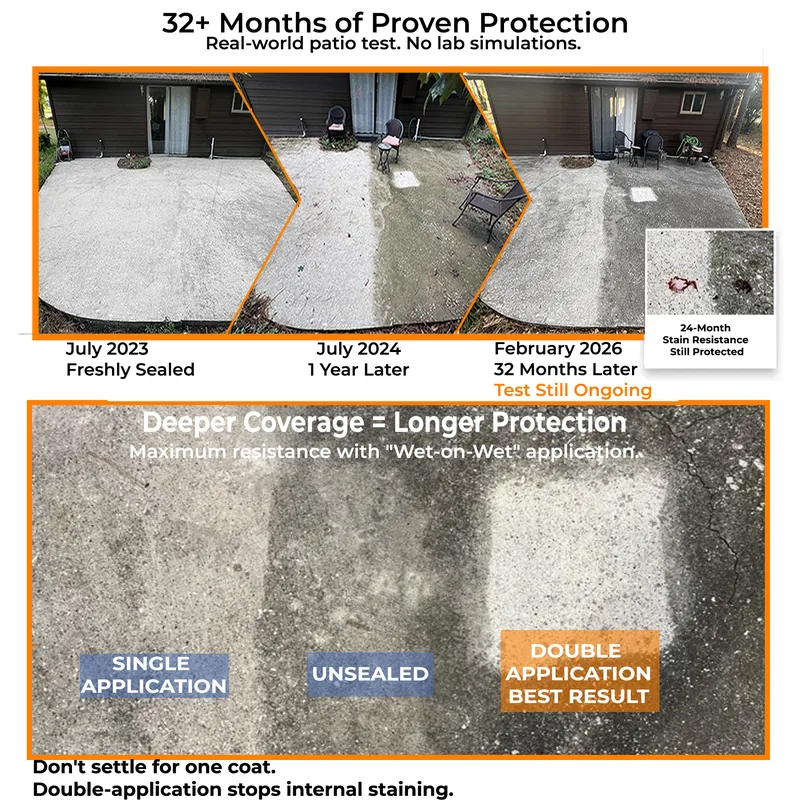
By Nanoprotect USA Testing Team — Verified by the Nanoprotect USA product testing team, who have maintained an ongoing outdoor concrete durability test since July 2023.
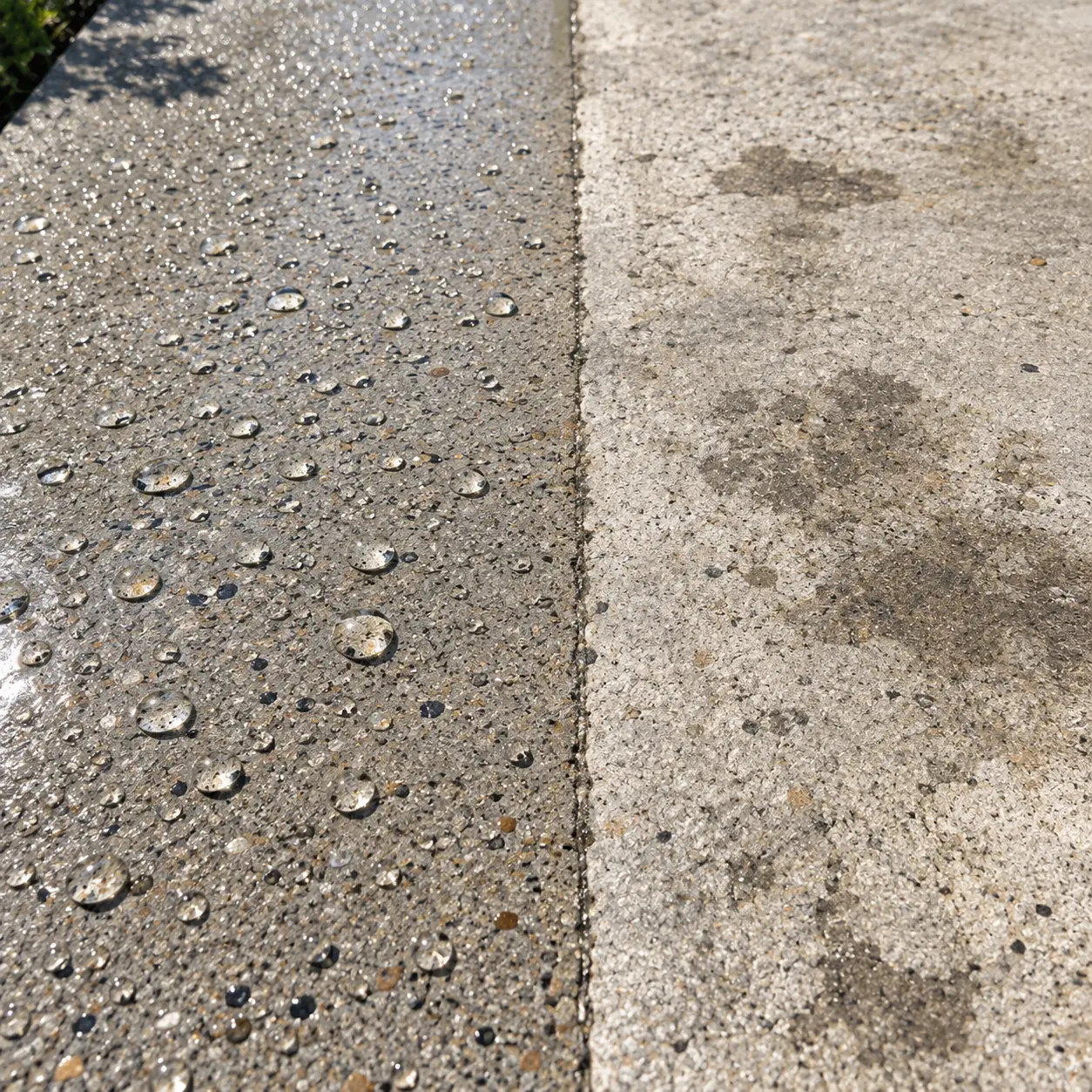
A penetrating concrete sealer is the most durable category of sealer money can buy — and the most misunderstood. This guide explains exactly what penetrating sealers are, how they work, how silane, siloxane and dual-depth formulas differ, and why a dual-depth 2-phase concrete sealer like Nanoprotect outperforms every topical coating on driveways, patios and pavers.
What is a penetrating concrete sealer?
A penetrating sealer is a reactive impregnator that soaks into concrete rather than sitting on top of it. The active molecules — typically silanes, siloxanes, or a combination — migrate into the capillary pores of the concrete and react with the alkaline minerals inside. That reaction creates a hydrophobic (water-repelling) lining on the inside walls of every pore.
The result: water, salt and oil can't enter, but water vapor can still escape. The concrete stays dry inside, doesn't spall in freeze-thaw cycles, and the surface looks identical to before sealing — no gloss, no darkening, no film.
How penetrating sealers work vs surface coatings
To understand why penetrating sealers win long-term, you have to understand what topical coatings actually do — and what goes wrong.
Topical sealers (acrylics, polyurethanes, epoxies) form a thin plastic film on top of the concrete. They look great for the first season — usually with a glossy "wet look" — but they have three structural problems:
- UV light breaks the polymer film down. Yellowing and chalking start within 12–18 months.
- Foot and vehicle traffic abrades the film. Hazing, peeling and fish-eyes follow.
- They trap moisture. Water vapor rising from the ground hits the film, condenses underneath, and blows the coating off in patches — taking the top layer of concrete with it.
A penetrating sealer has none of these failure modes. There is no film to UV-degrade, nothing on the surface for traffic to wear off, and the substrate stays vapor-permeable. The protection is inside the concrete, where weather can't reach it.
For a side-by-side comparison, see our penetrating vs topical sealer guide.
Why penetrating is better for driveways and patios
Driveways and patios are the two surfaces where topical sealers fail fastest — and where penetrating sealers shine.
- Driveways: Hot tires, road salt, oil drips and freeze-thaw cycles destroy acrylic coatings within 2 years. A penetrating driveway sealer handles all four with no surface to degrade.
- Patios: Outdoor furniture, planters and BBQ spills leave rust rings and stains on coated concrete. A penetrating patio sealer helps prevent stains from soaking in without changing the natural texture you actually want underfoot.
- Pavers: Topical paver sealers cloud up between joints and lock in efflorescence. A penetrating paver sealer protects each paver from the inside while letting the surface breathe.
Silane vs siloxane vs dual-depth formulas
Not all penetrating sealers are equal. The chemistry behind them — silane, siloxane, or a hybrid — determines how deep the protection goes and how long it lasts.
Silane sealers
Silanes have the smallest reactive molecule of any concrete sealer (about 1.5 nanometers). That small size lets them penetrate deep into dense concrete — up to 1/4 inch — and react far below the surface, where weather can't reach them. The trade-off: silanes are volatile. Used on their own, a significant portion evaporates before it can react, especially in warm weather. Pure-silane sealers tend to be expensive and best suited to dense, hard-troweled concrete.
Siloxane sealers
Siloxanes are larger molecules (around 5 nanometers) made of pre-linked silane chains. They don't penetrate as deep — usually 1/16 to 1/8 inch — but they react faster and don't evaporate as easily. Siloxanes are excellent for porous, lighter-broom-finish concrete and natural stone, where the bigger molecule can still find space to migrate.
Dual-depth (silane + siloxane) formulas
A dual-depth formula combines both: silane for deep substrate protection where it matters for freeze- thaw resistance, and siloxane for the surface and near-surface pores where water and stains actually enter. You get deep + surface protection in one application — and the two molecules complement each other, so almost nothing evaporates wasted.
Why Nanoprotect's dual-depth 2-phase formula is the most advanced option
Nanoprotect is built around a dual-depth 2-phase silane/siloxane chemistry. The two phases do different jobs at the same time:
- Phase 1 — deep silane penetration. A small silane molecule migrates 1/8 to 1/4 inch into the concrete and reacts at depth, anchoring the protection inside the substrate where weather and traffic can never reach it.
- Phase 2 — siloxane surface reaction. A larger siloxane molecule reacts in the upper pore network, creating the water-beading hydrophobic layer that visibly repels rain, salt and oil from day one.
Both phases cure inside the concrete. There is no film, no gloss, no color change. Independent field testing on a real driveway showed water still beading at the 34-month checkpoint from a single application — test ongoing, now 36+ months — something no acrylic or polyurethane topical coating can match.
On top of the chemistry, Nanoprotect is water-based, Ultra-Low VOC, PFAS-free and pet-safe once cured — a combination that's almost impossible to find in solvent-carried penetrating sealers from industrial suppliers.
How much do you need?
Penetrating sealers are sold by coverage rate, not by gallons of "look". Most penetrating concrete sealers cover roughly 150–250 sq ft per liter depending on porosity. Use the coverage calculator for the exact pack size for your driveway, patio or paver area.
Bottom line
A penetrating concrete sealer is the right choice for any outdoor concrete you want to protect for the long term without resealing every 1–2 years. Among penetrating options, a dual-depth silane/siloxane formula like Nanoprotect gives you deep + surface protection in a single application, with 36+ months of verified outdoor performance and Ultra-Low VOC. For more on choosing the right product for your surface, see the concrete sealer hub, driveway sealer, patio sealer or paver sealer guides.