
Best Concrete Sealer for Driveway in 2026 — After 34 Months of Real Testing
Updated May 2026
By Nanoprotect USA Testing Team — Verified by the Nanoprotect USA product testing team, who have maintained an ongoing outdoor concrete durability test since July 2023.
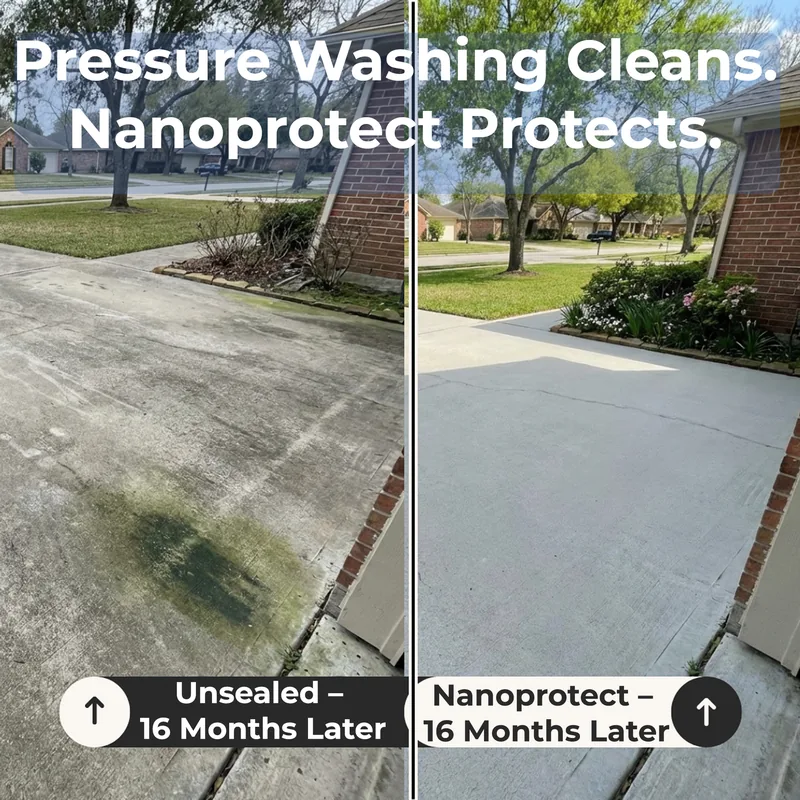
If you're tired of pressure washing your driveway every few months, you're in the right place. Choosing the right concrete sealer — and specifically the best driveway sealer for your slab — comes down to one thing: how deep it penetrates. The best concrete driveway sealer isn't always the most expensive — it's the one that soaks in, lasts years and never peels.
Penetrating sealers vs. topical coatings
Topical sealers sit on top of the concrete and form a film. They look great at first, but they peel, flake and yellow over time. A penetrating concrete sealer like Nanoprotect soaks into the concrete itself, protecting it from the inside out. The look of your driveway stays natural, and protection lasts much longer — see our penetrating concrete sealer guide for the chemistry behind why this matters.
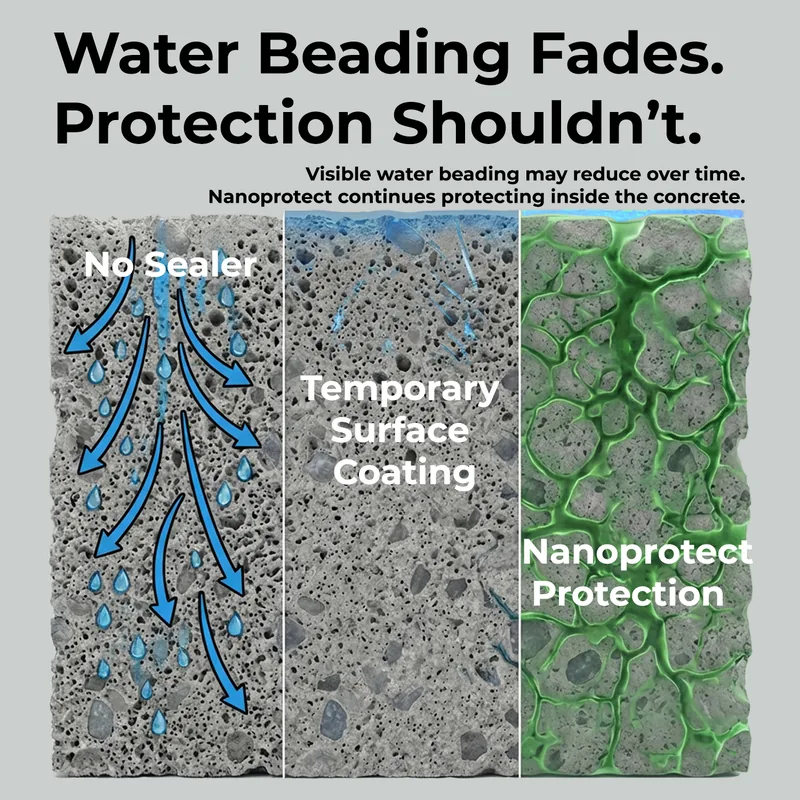
What to look for in a driveway sealer
- Deep-penetrating, not topical — a true outdoor concrete sealer built for weather exposure
- Proven longevity in real-world tests (not just lab claims)
- Water-based, zero VOC, no PFAS
- Pet safe after curing
- Helps reduce algae and resists stains
Industry guidance on durable concrete protection is published by the Portland Cement Association, which sets the standards we benchmark our testing against.
Why Nanoprotect is the best concrete sealer we tested
Nanoprotect's stone-impregnation formula has been independently tested A+ Outstanding and proven in 30+ month real-world field tests. One application using the wet-on-wet double seal method delivers 36+ months of protection.
Our 34-Month Real-World Driveway Test
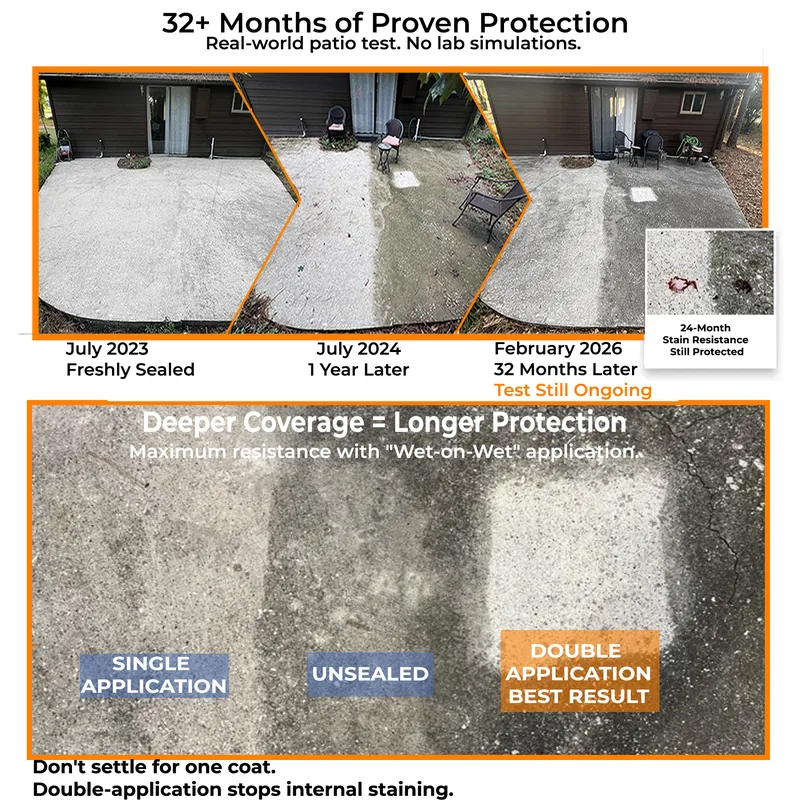
In July 2023 we sealed a real concrete driveway using three different methods to see exactly how each held up over time:
- Section 1 — Single coat: One application of Nanoprotect using the standard wet-on-wet method.
- Section 2 — Double coat: Two applications (wet-on-wet) for maximum penetration.
- Section 3 — Unsealed control: Left completely untreated to compare against.
We photographed and documented every section at regular intervals. Here's what we found:
At 6 months: The unsealed section showed early algae spotting. Both sealed sections remained clean and water-resistant.
At 12 months (July 2024): The unsealed section had visible algae and staining. The single-coat section was still clean. The double-coat section looked nearly identical to day one.
At 34 months (March 2026): During a heavy rainstorm we filmed all three sections side by side. The unsealed section absorbed every drop — turning dark and saturated within seconds. The single-coat section showed strong water resistance with minor absorption. The double-coat section repelled water completely — staying noticeably lighter and drier even during the heaviest rain.
The difference between the sealed and unsealed sections was visible from across the yard.
Penetrating vs Topical Concrete Sealers — Which Is Better for Driveways?
| Feature | Penetrating Sealer | Topical / Acrylic Sealer |
|---|---|---|
| How it works | Soaks into concrete | Sits on surface |
| Appearance | Natural, invisible | Glossy or wet look |
| Lifespan | 3–10 years | 1–3 years |
| Peeling / cracking | Never | Common after 1–2 years |
| Algae resistance | High | Medium |
| Reapplication | Every 3–5 years | Every 1–2 years |
| Best for | Driveways, patios, pavers | Decorative indoor concrete |
For driveways exposed to weather, vehicle traffic and freeze-thaw cycles, penetrating sealers are the clear choice. They become part of the concrete rather than sitting on top — which is why they last so much longer and never peel or yellow. For a deeper comparison, see our penetrating vs topical sealer guide and our breakdown of how long does concrete sealer last.
How Nanoprotect compares to other concrete driveway sealers
Not every concrete driveway sealer on the market is built the same way. Here's how Nanoprotect stacks up against the two most common alternatives homeowners shop for when looking for the best driveway sealer:
| Feature | Nanoprotect | Standard Acrylic Sealer | Basic Silane Sealer |
|---|---|---|---|
| Protection type | Deep penetrating (dual-depth) | Surface film coating | Single-depth penetrating |
| Lifespan | 36+ months confirmed | 1–2 years | 2–4 years |
| Application | Garden sprayer, DIY | Roller/brush, DIY | Sprayer, DIY |
| Surface appearance | Natural look preserved | Glossy/wet look | Natural look |
| Peeling risk | None — no surface film | High | Low |
| Algae protection | Yes | No | No |
| Made in USA | Yes | Varies | Varies |
Single Coat vs Double Coat — Does It Make a Difference?
Our 34-month test answers this definitively: yes, the double coat makes a significant difference in long-term performance.
The wet-on-wet double application method allows the second coat to penetrate even deeper while the first coat is still open. This creates a denser protective barrier that visibly outperforms a single coat after 2+ years.
Recommendation: For driveways and high-traffic areas, always apply two coats. For patios and low-traffic areas, a single coat provides excellent protection — see our patio sealer guide and our walkthrough on how to seal a concrete patio.
How to Apply Concrete Sealer to Your Driveway
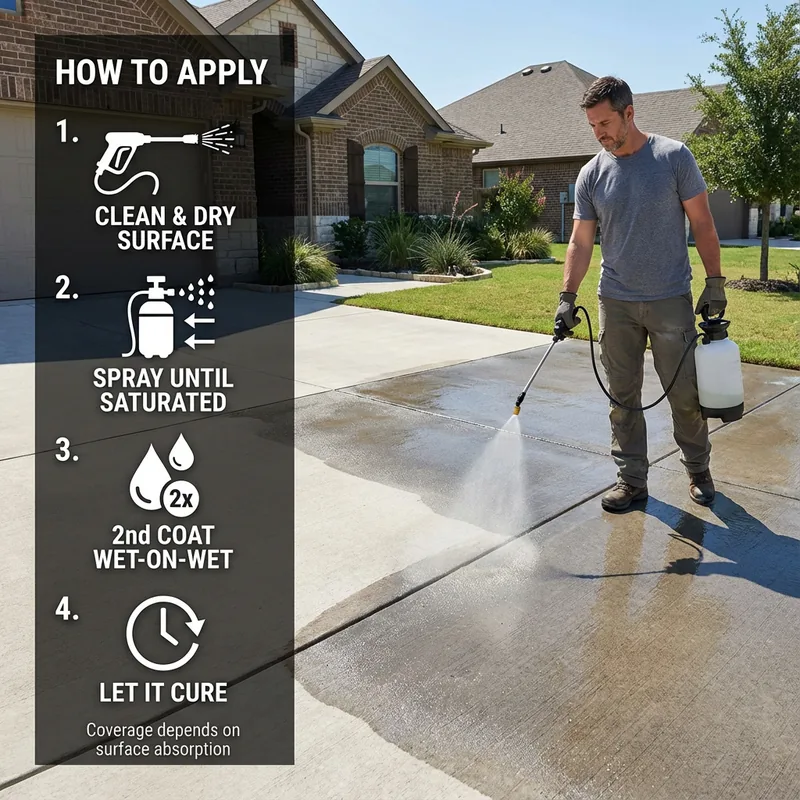
Applying Nanoprotect takes about 20–30 minutes for a standard driveway. Here's the exact process:
What you need
- Nanoprotect concrete sealer (1 gallon covers 135 sqft double coat)
- Pump sprayer or low-nap roller
- Clean, dry driveway surface
Step by step
- Clean the surface — remove oil stains, algae, dirt and debris. Allow to dry completely (at least 24 hours).
- Check the weather — apply in temperatures between 50°F and 85°F with no rain forecast for 24 hours.
- Apply first coat — using a pump sprayer in overlapping passes, working section by section.
- Apply second coat immediately — while the first coat is still wet (wet-on-wet method). This is the key to maximum penetration.
- Allow to cure — 24 hours before foot traffic, 48 hours before vehicle traffic.
Not sure how much you need? Use our coverage calculator to get an exact estimate for your driveway size. Sealing pavers instead? See how long does paver sealer last and our paver sealer guide.
How Long Does Concrete Sealer Last?
This depends entirely on the type of sealer:
- Topical acrylic sealers: 1–3 years. Need annual inspection and reapplication every 1–2 years.
- Penetrating silane/siloxane sealers: 3–7 years depending on traffic and weather conditions.
- Nanoprotect impregnating sealer: 36+ months confirmed in our real-world test — and still going at 34 months.
The key difference is that penetrating sealers don't degrade from UV exposure or traffic the way topical sealers do. They're inside the concrete, not on top of it.
Frequently Asked Questions
What is the best concrete sealer for driveways in 2026?
For long-lasting protection, a deep-penetrating impregnating sealer like Nanoprotect is the best choice. It soaks into the concrete, lasts 36+ months in real-world conditions, and never peels or yellows. Our 34-month outdoor test confirms it still actively repels water after nearly 3 years.
How often should you seal a concrete driveway?
With a quality penetrating sealer, you should only need to reseal every 3–5 years. Topical sealers typically need reapplication every 1–2 years. Our Nanoprotect test driveway has not been resealed since July 2023 and is still fully protected at 34 months.
Can I apply concrete sealer myself?
Yes — it's a straightforward DIY project. You need a clean dry surface, a pump sprayer or roller, and about 20–30 minutes for a standard driveway. No special skills or equipment required.
What happens if you don't seal a concrete driveway?
Unsealed concrete absorbs water, algae, oil and deicing salts. Our unsealed control section showed visible algae and staining within 6 months. Over time this causes cracking, spalling and costly repairs.
Is penetrating or topical sealer better for driveways?
Penetrating sealer is better for driveways. It lasts 3–5x longer, never peels or cracks, maintains the natural look of concrete, and provides superior protection against moisture and algae.
How much concrete sealer do I need for my driveway?
One gallon of Nanoprotect covers approximately 135 square feet with a double coat, or up to 200 square feet with a single coat. Use our coverage calculator for an exact estimate.
Ready to Stop Pressure Washing Every Year?
Nanoprotect is the only concrete sealer backed by a real 34-month outdoor test — not lab simulations. One afternoon of work. 3+ years of protection.