
Deep Penetrating Sealer: How to Choose One & Our Top Pick for 2026
Updated September 2026
By Nanoprotect USA Testing Team — Verified by the Nanoprotect USA product testing team, who have maintained an ongoing outdoor concrete durability test since July 2023.
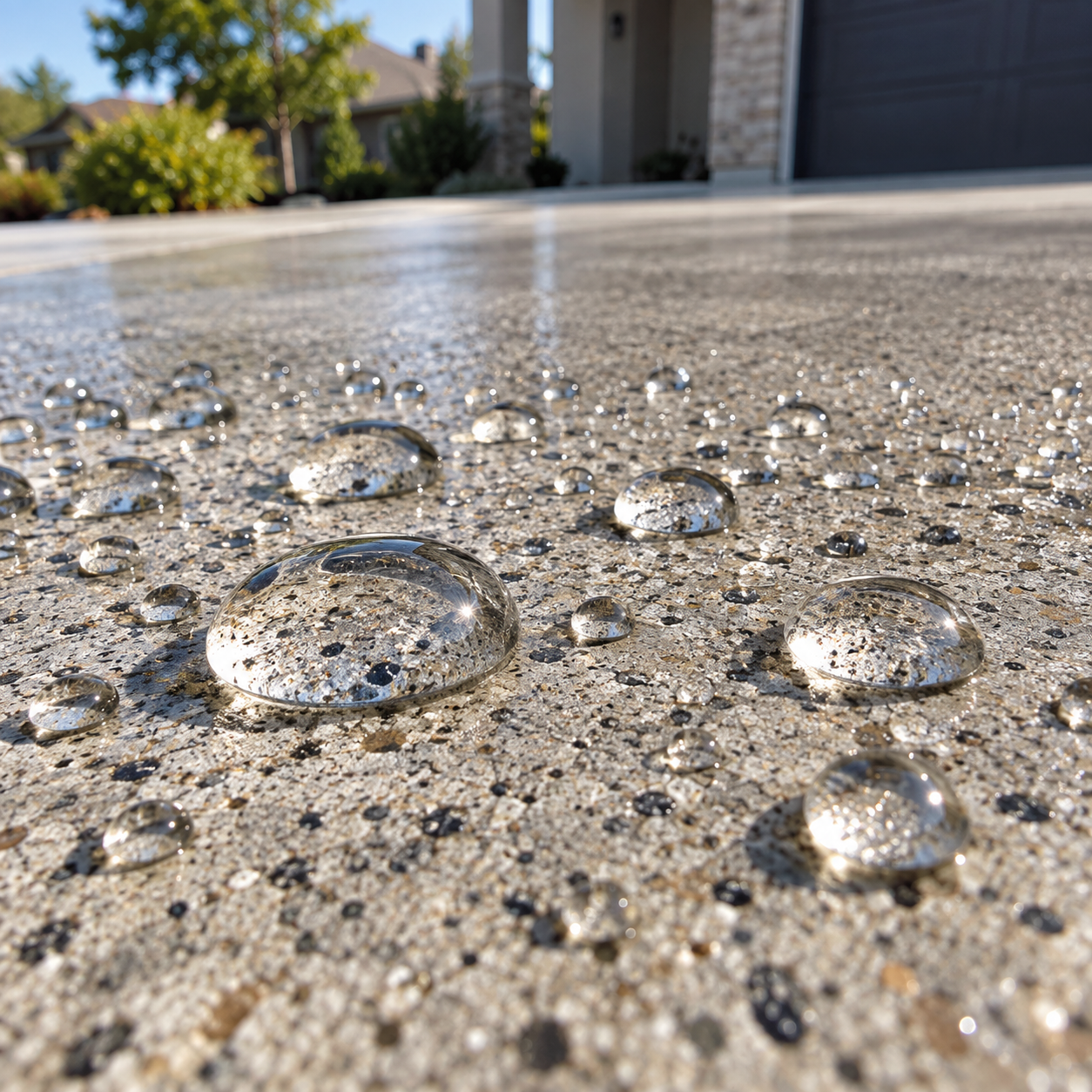
A deep penetrating sealer is a sealer designed to migrate below the surface of concrete, stone or masonry instead of sitting on top of it as a film. The deeper the active molecule reaches into the pore structure, the longer the protection lasts and the less it depends on weather, UV or foot traffic to survive. This guide covers what "deep penetrating" actually means, the five things worth checking before you buy one, and how the leading options compare.
Want the full chemistry breakdown first? See our penetrating concrete sealer guide covering silane, siloxane and dual-depth formulas in detail.
Key takeaways
- "Deep penetrating" refers to a specific depth range — ideally 1/8 to 1/4 inch below the surface — not just a marketing phrase.
- Industry research on penetrating sealers has used a minimum penetration depth of 1/16 inch as the baseline for acceptable performance; true deep-penetrating sealers go well beyond that.
- The five things to check before buying: stated depth, single-molecule vs. dual-depth chemistry, water-based vs. solvent-based, independently verified field results, and surface compatibility.
- A dual-depth (silane + siloxane) formula avoids the depth-vs-cure-speed trade-off of single-chemistry sealers.
What "deep penetrating" actually means
Not every sealer marketed as "penetrating" reaches the same depth. Depth depends almost entirely on molecule size:
- Under 1/16 inch — larger, slower molecules that mostly treat the surface pores. Cheap, but closer to a light surface treatment than true depth protection.
- 1/16–1/8 inch — typical siloxane range. Good for porous, broom-finish concrete and natural stone.
- 1/8–1/4 inch — silane range, and the deepest a reactive sealer reaches. This is where "deep penetrating" earns its name — the protection sits below where freeze-thaw cycles, salt and traffic can ever reach it.
A sealer that only treats the top few millimeters isn't wrong for every job, but it isn't what most people searching for a deep penetrating sealer actually need — usually a driveway, patio or garage floor exposed to weather, vehicles and years of wear.
Industry bodies including the American Concrete Institute, the Portland Cement Association and the National Ready Mixed Concrete Association point to surface moisture intrusion as the leading cause of concrete deterioration — freeze-thaw scaling, corrosion of embedded steel, and cracking from alkali-silica reaction. That's the exact mechanism a deep penetrating sealer is designed to block, by lining the pore structure below the surface rather than treating the surface itself.
What should you check before buying a deep penetrating sealer?
1. Penetration depth, stated in inches — not marketing language.
"Deep penetrating" on a label means nothing without a number. Look for a stated depth (ideally 1/8 inch or deeper) rather than vague claims like "penetrates deep into concrete."
2. Single-molecule vs. dual-depth chemistry.
A pure silane sealer penetrates deepest but reacts slowly and can evaporate before curing in warm weather. A pure siloxane sealer cures faster and resists evaporation but doesn't go as deep. A dual-depth (silane + siloxane) formula gets both: deep substrate protection and a faster-curing surface layer in one application.
3. Water-based vs. solvent-based.
Solvent-carried penetrating sealers are common in industrial supply, but carry strong VOC emissions and aren't pet- or plant-safe until fully cured — sometimes for days. A water-based, zero-VOC formula covers the same chemistry without the fumes.
4. Independently verified field performance, not just a lab data sheet.
Lab specs tell you how a sealer performs in a controlled environment. A multi-year outdoor field test — through real freeze-thaw cycles, real rain and real traffic — tells you how it performs on your driveway.
5. What surfaces it's rated for.
Some penetrating sealers are formulated for dense, troweled concrete only and underperform on porous stone, pavers or broom-finish surfaces. Confirm the sealer is rated for your specific surface before buying.
Which deep penetrating sealer is best?
| Penetration depth | Chemistry | VOC | Field-tested duration | |
|---|---|---|---|---|
| Nanoprotect | 1/8–1/4 in (dual-depth) | Silane + siloxane | Zero VOC, water-based | 36+ months, ongoing |
| Typical single-siloxane sealer | 1/16–1/8 in | Siloxane only | Often solvent-based | Varies by brand |
| Typical single-silane sealer | 1/8–1/4 in | Silane only | Often solvent-based | Varies by brand |
(Looking for a head-to-head against a specific brand? Our Siloxa-Tek 8500 and Seal-Krete Original comparisons break down pricing, coverage and real-world results side by side — coming soon.)
Why we recommend a dual-depth formula
Single-chemistry sealers force a trade-off: go deep and cure slowly (silane), or cure fast and stay shallow (siloxane). Nanoprotect's dual-depth 2-phase formula avoids that trade-off entirely — a silane phase reacts 1/8 to 1/4 inch below the surface for long-term structural protection, while a siloxane phase reacts near the surface, creating the visible water-beading layer that shows the seal is working from day one.
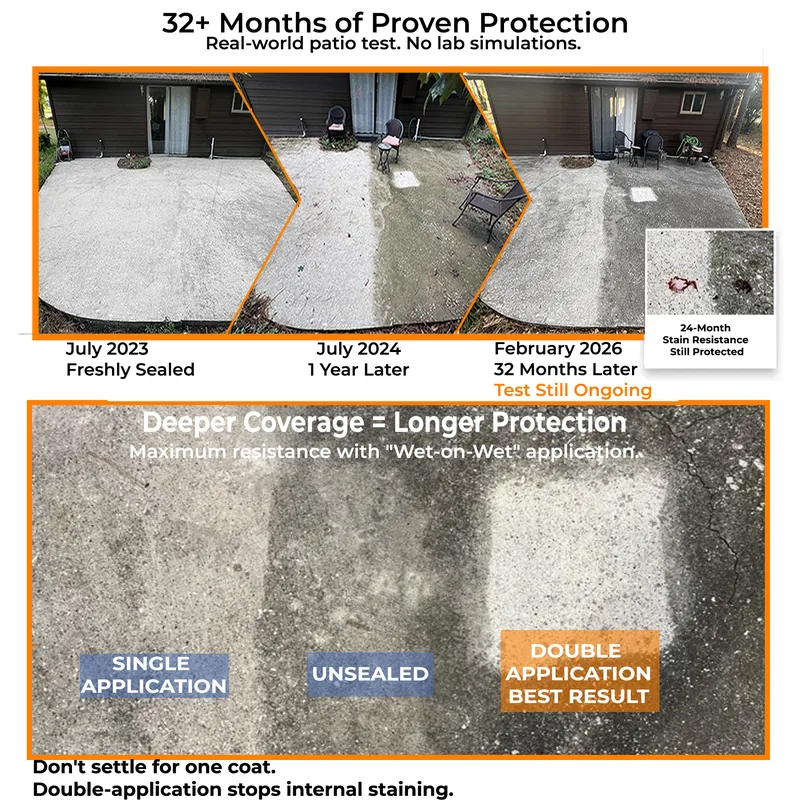
On a real driveway, sealed in July 2023 and tested outdoors ever since, water is still beading at 34+ months — through multiple winters of freeze-thaw and road salt. See the full driveway sealer test results for photos and method.
Nanoprotect is also water-based, zero VOC, PFAS-free and pet-safe once cured — properties that are difficult to find together in solvent-carried industrial penetrating sealers.
What are homeowners saying?
Beyond lab data and our own field test, real-world reviews matter. Nanoprotect has 3,175+ verified reviews globally on Amazon, with homeowners reporting the same result our field test shows: water still beading and stains still resisting years after a single application.
Independent homeowner experiences point the same direction. In a two-year side-by-side patio test shared on r/ConcreteSealersusa, a homeowner in North Houston, TX — a climate with heavy humidity, rain, and occasional winter frost — sealed half a patio with a penetrating sealer and left the other half untreated as a control, with a small double-coated patch for comparison. After two years with zero cleaning or pressure washing, the double-coated section still looked close to day one — no algae, staining or buildup — while the unsealed side developed visible algae and grime. The single-coated area no longer beaded water as dramatically as in the first months, but still resisted dirt and moisture penetrating the surface. The homeowner's takeaway: a double coat clearly outperformed a single one over the long term — the same wet-on-wet double-seal method we recommend for Nanoprotect.
How much deep penetrating sealer do you need?
Coverage depends on the concrete's porosity and whether you're applying one or two coats. Use the coverage calculator to get an exact pack size for your driveway, patio or paver area before you buy.
Frequently asked questions
What is a deep penetrating sealer?
A deep penetrating sealer is a reactive impregnator — typically silane, siloxane, or a combination of both — that migrates into the pore structure of concrete, stone or masonry and chemically bonds below the surface, rather than forming a film on top.
How deep does a "deep penetrating" sealer actually go?
The deepest reactive sealers, based on silane chemistry, reach 1/8 to 1/4 inch below the surface. Siloxane-based sealers typically reach 1/16 to 1/8 inch. A dual-depth formula combines both ranges in one application.
Is a deep penetrating sealer better than a topical (film-forming) sealer?
For long-term outdoor protection, yes. Because the protection sits inside the concrete instead of on top of it, a deep penetrating sealer isn't affected by UV yellowing, abrasion from traffic, or moisture trapped under a film — the three most common failure points of topical coatings.
Can I apply a deep penetrating sealer myself?
Yes. Most deep penetrating sealers are designed for DIY application with a pump sprayer, roller or brush — no special equipment or licensing required.
How long does a deep penetrating sealer last?
It depends on the formula. Nanoprotect's dual-depth formula has 36+ months of verified outdoor protection from a single application; many single-chemistry sealers are rated for 1–2 years before resealing is needed.
Bottom line
A deep penetrating sealer is the right call whenever you want protection that survives weather, salt and traffic without resealing every year — and the depth of penetration is the single most important spec to check before buying. Among deep penetrating options, a dual-depth silane/siloxane formula like Nanoprotect delivers both the deep substrate protection and the fast-curing surface layer, backed by 36+ months of real-world outdoor testing.